
For decades, customer service has been governed by workflows. A ticket is logged, routed, escalated, and eventually closed. Enterprises have invested heavily in optimizing this model through automation, analytics, and process engineering. Despite measurable efficiency gains, the underlying paradigm has remained largely unchanged. Workflows are inherently reactive, rigid by design, and slow to respond to dynamic customer needs.
A new operating model is now emerging. Instead of linear workflows, enterprises are beginning to deploy autonomous AI agents, each aligned to a specific business function, capable of reasoning, negotiating, delegating tasks, and acting in real time.
This is not incremental automation; it represents a structural shift in how customer service is orchestrated, moving from process-driven execution to intent-driven, agent-led operations.
Observability without control creates false confidence
Enterprises have made real progress in observing complex Data and AI systems. With modern tracing and telemetry standards, it’s now possible to see how agents interact, where decisions are made, and how outcomes emerge. This level of transparency represents a significant advance compared to earlier generations of distributed systems.
But visibility is not operational maturity.
In enterprise environments, the ability to observe failure without the authority to intervene undermines trust. Seeing an agentic workflow spiral into a loop, knowing exactly what’s happening, yet having no option beyond a full shutdown, does not constitute control. It is a containment.
Observability tells you what is happening. Control determines whether the system can be relied upon at scale.
Without the ability to intervene, isolate, or redirect behavior, transparency becomes passive. Passive systems force organizations back into reactive operating modes, precisely what agentic architectures are meant to move beyond.
Why existing operational tools fall short
Most operational tools were built to orchestrate infrastructure. They were not designed to govern intelligent, adaptive behavior.
In multi-agent systems, real work happens in coordination. Agents negotiate, hand off decisions, and adapt in real time. When something breaks, failures rarely originate at the infrastructure layer; they emerge from interactions between agents.
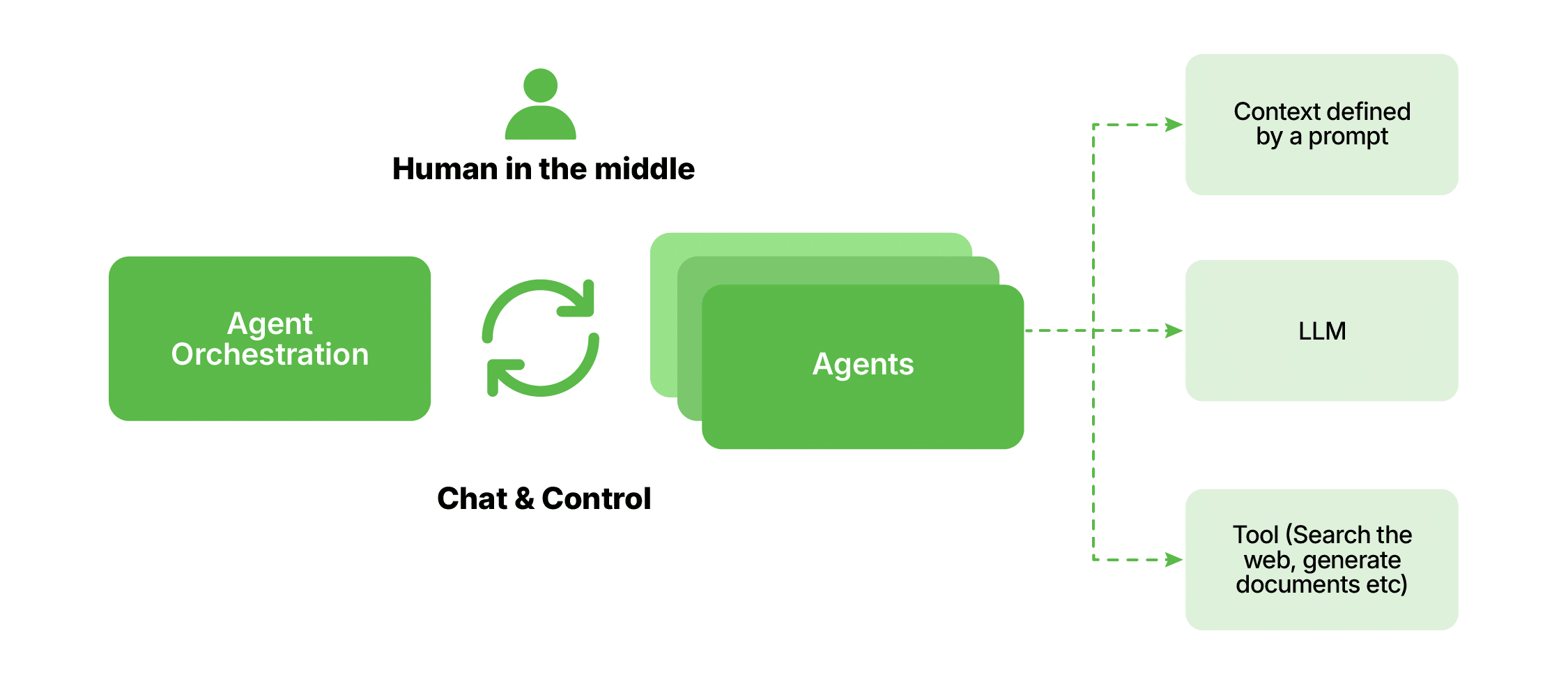
Most enterprise tooling is not designed to operate at the level where agentic systems actually function. There is no native concept of pausing an agent in mid-decision, isolating a faulty negotiation, or redirecting intent while execution is in progress. When issues arise, the only available response remains infrastructure-level intervention.
That response is inherently blunt and costly. Stopping a container to resolve one faulty interaction interrupts every healthy workflow running alongside it. Throughput is reduced, context is lost, and business continuity is impacted, even though the failure was localized.
Multi-agent systems require orchestration at the agent level, not infrastructure. Until governance mechanisms evolve to operate at this layer, enterprises will continue managing intelligent systems with tools designed for a pre-agent operating model.
Moving from workflows to multi-agent collaboration
Consider a familiar scenario; a customer notices a billing error and contacts support. In a traditional model, this triggers a linear chain of events. Support logs the issue, escalates it to billing, waits for compliance review, and eventually involves technical teams. Even straightforward issues can take days to resolve under this model.
Read more: Multi-agent AI systems as an enterprise operating model
In a multi-agent system, each of those functions is represented by an intelligent agent:
- The billing agent validates the claim.
- The compliance agent checks for policy violations.
- The technical agent investigates system logs.
- A customer experience agent evaluates the customer’s history and sentiment.
These agents don’t wait for instructions. They collaborate autonomously within defined constraints, negotiate trade-offs, and converge on a resolution, often far faster than traditional escalation paths. In many cases, the customer receives a correction, a clear explanation, and even a proactive concession before they have fully articulated the issue.
The architectural choices behind multi-agent systems
As multi-agent systems move into real operating environments, their architectures begin to show their consequences. How agents are structured directly influences scalability, resilience, and governance under pressure.
Two patterns show up consistently.
Centralized networks
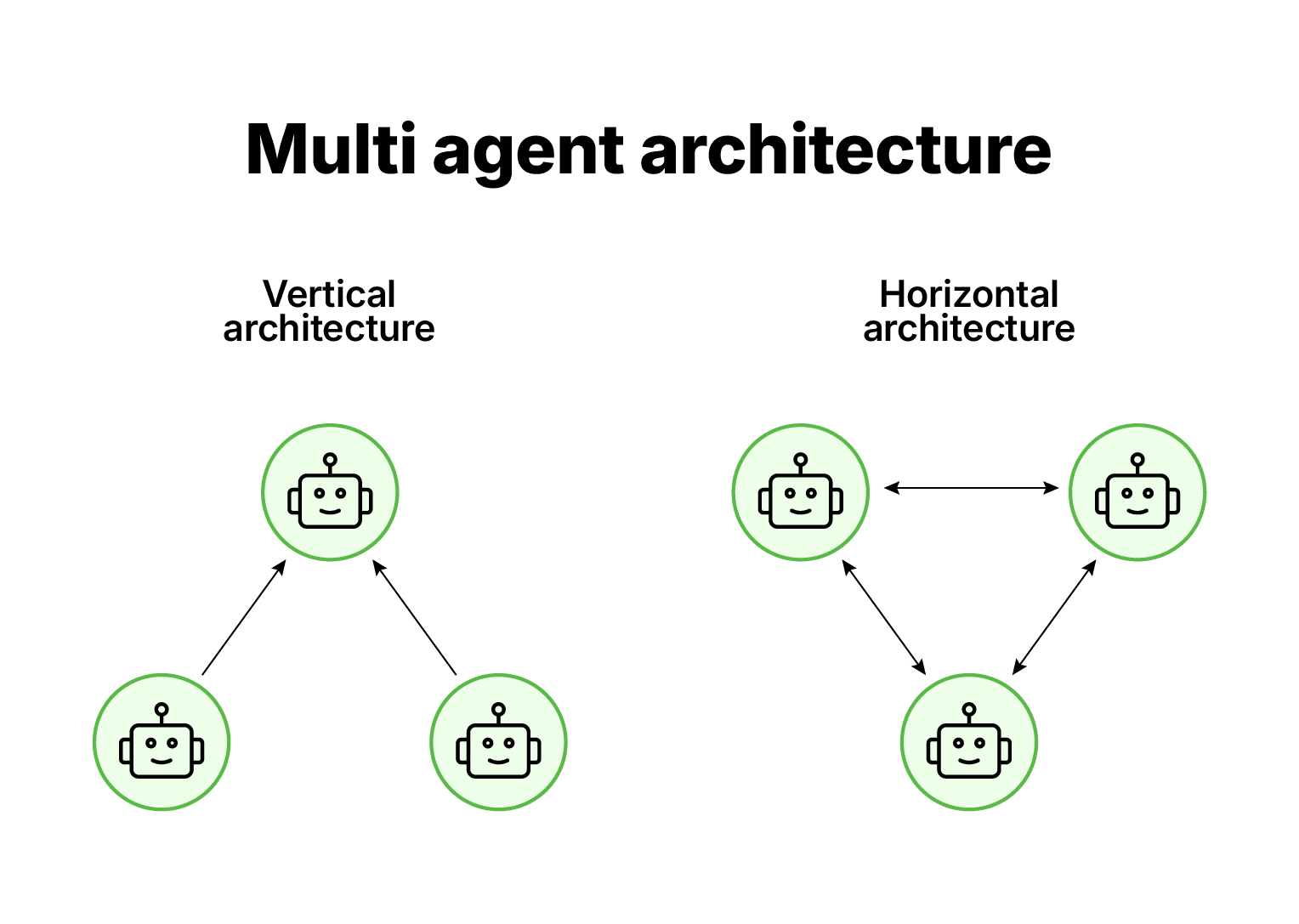
In centralized architectures, agents operate against a shared global knowledge base and are coordinated through a central control layer. This model brings early alignment. Decisions remain consistent across the system; coordination is predictable, and governance is easier to establish during initial rollout.
As scale grows, the trade-offs become harder to ignore. The central layer becomes a systemic dependency, and any degradation at that point affects the entire system. Centralized designs preserve control, but they constrain adaptability as decision velocity and complexity increase.
Decentralized networks
In decentralized architectures, agents coordinate directly with one another instead of relying on a single authority. This removes single points of failure and allows the system to continue operating even when individual agents drop out or behave unpredictably.
The challenge shifts from resilience to alignment. Without explicit intent, constraints, and shared objectives, decentralized systems tend to optimize locally. Over time, this drift can move outcomes away from organizational priorities.
Case in point: Where multi-agent systems deliver real value
Across diverse enterprise environments, a consistent pattern emerges. Failures rarely stem from a lack of intelligence in the system. They occur when decisions span teams, systems, and timelines that lack alignment.
I’ve seen this clearly in healthcare, supply chain, and security-driven contexts. Decisions draw from multiple signals that evolve at different speeds and interact in unpredictable ways. In those moments, linear workflows fall behind. Multi-agent systems change outcomes by coordinating those signals in real time, allowing responses to adapt as conditions shift.
What ultimately made the difference was not better data or more sophisticated models. It was the ability for agents to interact, negotiate, and adjust continuously, without waiting for centralized control.
That’s the point where multi-agent systems move from concept to enterprise capability.
Why control becomes the defining question
As AI-native workflows become more autonomous, control cannot remain peripheral. The challenge is no longer visibility, but governance.
A modern control layer has to operate at the workflow level, not the infrastructure level. In practical terms, that means it must be able to:
- Understand the structure and real-time state of each workflow as it runs
- Enforce enterprise and compliance policies dynamically, based on context
- Allow teams to inspect, debug, and intervene without shutting down healthy processes
- Detect anomalies by learning what normal behavior looks like, not just reacting to failure
- Turn observability into action, enabling precise intervention instead of blunt restarts
This isn’t a tooling discussion; it’s an enterprise one. As autonomy moves into the core of operations, control becomes the mechanism that preserves trust. Much like ERP systems once brought discipline to business processes, an AI-native control layer brings discipline to intelligent systems.
Conclusion: What leaders need to recognize
As multi-agent systems move into the core of business operations, the challenge is no longer about deploying AI. It is sustained, responsible operation at scale.
Customer service, like many other enterprise functions, has crossed a threshold. It is no longer a workflow to optimize, but a dynamic system where decisions unfold in parallel, coordination matters, and outcomes depend on how well autonomy is governed.
Organizations that succeed will approach this shift deliberately. They will design interaction, accountability, and trust alongside intelligence. Those who do not risk investing in systems can observe but cannot confidently control.
At Confiz, we work with enterprises to make this transition practical, supporting AI-driven operations across environments such as Dynamics 365 and helping teams move from experimentation to secure, dependable systems built to operate with confidence at scale.
If you’re ready to rethink how your organization turns autonomy and data into actionable intelligence, contact us today to start the conversation!