
For years, organizations have been investing heavily in modern data stacks, cloud platforms, and analytics programs. Yet a familiar frustration still echoes across boardrooms:
“We have a lot of data… but where is the business value?”
The answer is becoming clearer:
Traditional data products and pipelines were never built for the expectations of the AI era. As enterprises accelerate their Data and AI initiatives, leaders are no longer asking for dashboards or descriptive reporting. They want intelligence; systems that recommend, automate, predict, and act.
This is why the most significant shift underway isn’t technological; it’s organizational.
Data products are becoming AI products.
And this evolution requires a fundamentally different way for data teams to think, operate, and deliver impact.
From data products to AI products: A modern enterprise maturity curve
Traditional data products were designed to answer familiar analytical questions:
- What happened?
- Why did it happen?
- Where are the gaps?
But modern AI products don’t just describe reality; they shape it.
An AI product:
- Predicts churn
- Recommends actions
- Automates document-heavy workflows
- Detects anomalies
- Personalizes customer experiences
- Summarizes knowledge and accelerates decisions
- Learns and adapts continuously
This is the point where AI products transform data from a static asset into a living, evolving capability.
And as business expectations grow, every high-value data product eventually evolves into an AI product:
- Demand forecasting → Autonomous planning
- Customer segmentation → Real-time next-best-action
- Document extraction → End-to-end processing
- BI dashboards → Intelligent copilots
This evolution is at the core of today’s Enterprise AI agenda — and it is fundamentally redefining the skills, roles, and operating models required inside data teams.
Leadership insight, in their own voice. Listen to the full piece here.
Take control of your business operations
Discover how Confiz services can simplify your complex workflows and improve decision-making.
Get a Free QuoteThe gap: Why do AI initiatives struggle to deliver business value?
The problem isn’t the availability of AI technology, but it’s the disconnect between AI development and the realities of the business.
Across industries, the same patterns continue to appear:
AI models are often built in isolation, far removed from real on-ground processes. Proofs of concept stall before reaching production. Technical outputs are created without clear business value. Adoption weakens after launch. And teams remain siloed, with no shared ownership of outcomes.
Further readings: Explore AINAF: Our AI Native Assessment Framework for enterprise readiness
In other words:
AI fails not because of algorithms. It fails because teams are too far away from the business problem. This is exactly why we need a new AI delivery model — the forward-deployed AI team.
Why the forward-deployed model is redefining data teams?
A forward-deployed AI team will bridge the gap between AI capability and business impact.
The team would have forward-deployed engineers, part engineer, part consultant, part product thinkers, directly embedded with the customer.
They work side-by-side with business users, frame problems in business language, prototype quickly, and integrate solutions into real workflows. This proximity allows them to validate value early, drive adoption, and close the gap from POC to production.
This is how modern AI product development succeeds. Not by writing more code but by being closer to the problem, the context, and the people.
As AI automates more technical complexity, the differentiators shift toward business understanding, domain expertise, product thinking, human-centered design, and the ability to influence adoption. This is the next generation of modern data teams.
How does the forward-deployed AI model work end-to-end?
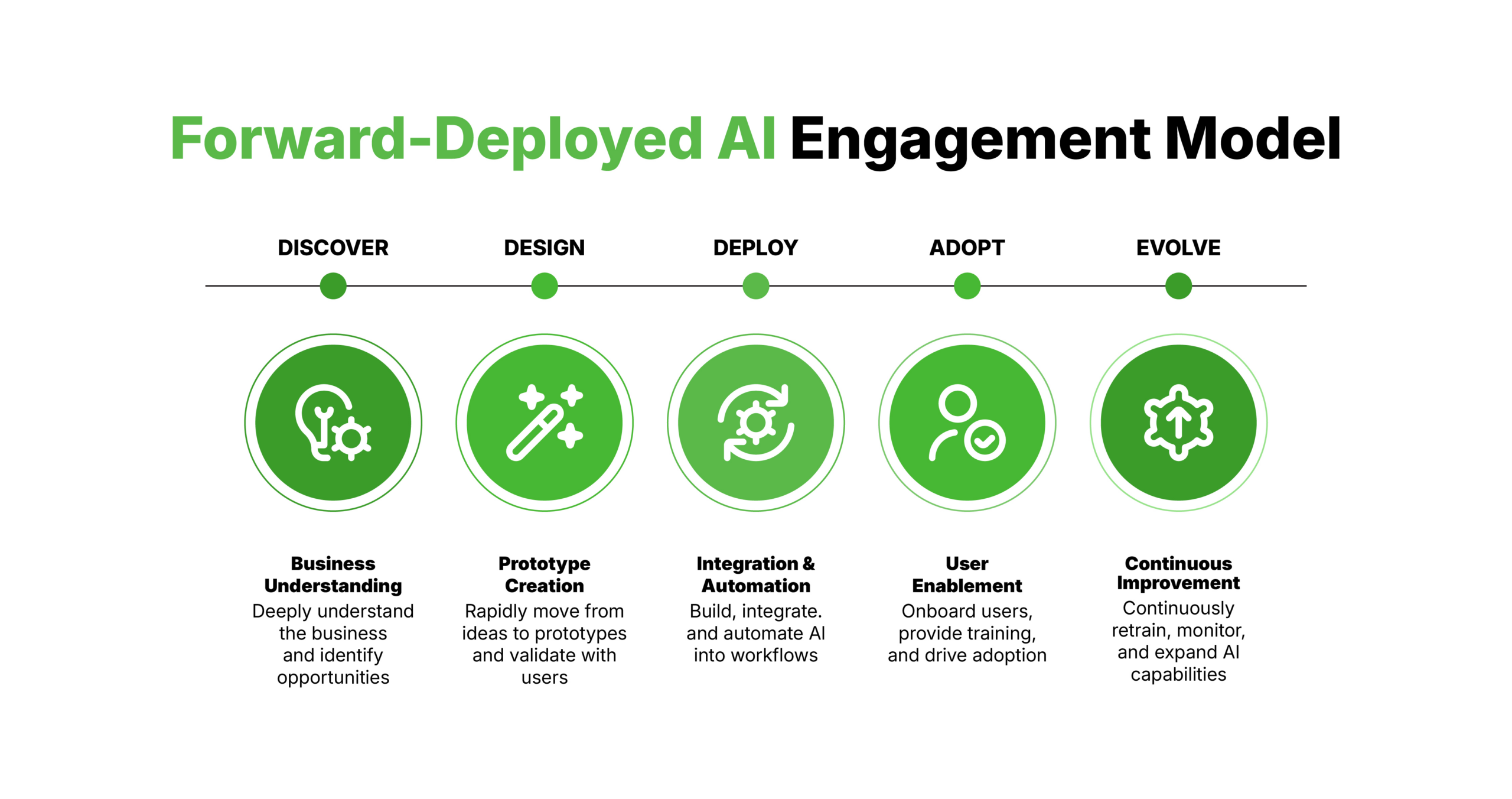
The forward-deployed model delivers AI through a structured, continuous process designed to validate value early and embed solutions directly into real operations. In practice, the model follows five stages:
1. Discover
Map the business landscape through workshops, process exploration, and clear problem framing to ensure the team is solving the right challenge.
2. Design
Translate insights into rapid prototypes, visualize the solution, and validate assumptions early with actual users.
3. Deploy
Build, integrate, and operationalize AI within real workflows — not as standalone outputs but as part of everyday processes.
4. Adopt
Drive training, change management, and user enablement to ensure the solution is embraced and used consistently.
5. Evolve
Establish continuous feedback loops for retraining, refinement, and scaling as business needs and data evolve.
This structured loop enables data products to mature into AI products — delivering solutions that are adopted, iterated, and tied directly to measurable business outcomes.
Case study: How the forward-deployed model accelerated AI value
A recent engagement with an asset management organization demonstrates clearly how the forward-deployed AI team improves delivery. Instead of relying solely on documented requirements, our engineers worked directly inside the business environment, observing real workflows, decision paths, and operational constraints.
This on-ground immersion surfaced insights that traditional delivery models typically overlook, including:
- Real business documents
- Inconsistencies in the process
- Unstated pain points the business didn’t have language for
- Decision logic hidden in back-and-forth emails
With a clearer understanding of the business context, the team was able to shape an AI solution that aligned tightly with how work actually happened — not how it was assumed to happen.
This approach resulted in:
- Higher adoption
- Improved trust
- Faster value delivery
- Stronger appreciation of the AI team as a partner
What I’ve learned from running AI discovery workshops?
Through multiple AI Discovery Workshops with customers (based on our Confiz Launchpad methodology), one pattern consistently emerges: organizations aren’t looking for more technology — they’re looking for a partner who can help them think through where AI creates value.
In nearly every session, leaders express the same needs: a clearer understanding of where AI fits, a partner who understands their processes, and a co-creation approach that stays involved until value is realized.
These workshops reinforce a simple truth:
AI succeeds in the early stages — before any model is built.
Real impact comes from combining business problem-solving, domain insight, user journey exploration, rapid prototyping, feasibility assessment, and clear ROI definition.
This mindset is exactly what the modern data team — and the FDE model — is built for.
Accelerate growth at an unprecedented pace
Discover how Confiz can help you take control of your daily operations, increasing growth and revenue.
Book a Free ConsultationLooking ahead: The new skill set shaping data & AI teams
As organizations advance their Data & AI agendas, the expectations from data teams are shifting. Technical skills alone are no longer enough. What matters now is the ability to link AI to real business needs.
Modern teams need a mix of business understanding, data product thinking, user-centric design, and the capability to operationalize and support AI in real workflows. The ability to run discovery sessions, interpret domain logic, prototype quickly, and guide adoption is becoming just as important as building models.
The message is clear: companies don’t just want technologists — they want problem-solvers who understand how the business works.
Because data products, AI models, and dashboards only create value when the people behind them are close to the business, move ideas into production, and ensure solutions are adopted and evolved.
This is the direction Data & AI teams are heading:
forward-deployed, business-led, and outcome-driven data and AI teams.
And the organizations that excel will be the ones that embed intelligence into how work truly gets done.
Conclusion: AI delivery as a strategic capability
As data products evolve into AI products, the real differentiator for enterprises is no longer tooling but the model through which AI is delivered. Organizations that embrace forward-deployed, business-led approaches will move beyond experimentation toward AI solutions that are adopted, trusted, and tied directly to measurable outcomes.
At Confiz, we partner with business and technology leaders to strengthen their AI delivery model, helping teams operationalize enterprise AI, accelerate data platform modernization, and build solutions that reflect real processes and deliver real impact.
If you’re ready to rethink how your organization turns data into intelligence, let’s connect.