
In 2025, Microsoft’s shift toward user-based licensing in Dynamics 365 Finance and Supply Chain Management will become a defining moment for CFOs and transformation leaders. What was once a compliance checkbox is now a strategic lever. Misaligned licenses are no longer just an IT inefficiency; they are a hidden tax on ERP transformation, eroding margins and slowing agility.
But the landscape is shifting. Forward-looking enterprises are beginning to recognize that license design is no longer just a technical necessity; it is a strategic enabler. By deliberately aligning license structures with business roles and measurable outcomes, companies can move beyond the narrow goal of avoiding overspend and instead unlock agility, accountability, and performance gains across the enterprise.
With Microsoft now steadily enforcing user-based licensing models in D365 Finance & SCM, the real question isn’t “what license does this user need?” but rather “what outcome should this role deliver and how can license design accelerate that outcome?
Further readings: Discover what’s changing in Microsoft’s D365 F&SCM license enforcement starting 2025.
With years of experience working across Dynamics 365 ERP, it’s clear that the upcoming licensing changes demand a fundamental shift in mindset. Organizations can no longer treat licensing as a back-office function – they must approach license design as an organizational strategy, aligning ERP access directly with business outcomes. That is precisely the perspective we’ll explore in this piece.
Leadership insight, in their own voice. Listen to the full piece here.
Why is license design a board-level priority in 2025?
Microsoft’s licensing evolution has forced organizations to rethink how D365 Finance and SCM licenses are assigned and monitored. However, simply shifting to user-based licensing without strategy can create inefficiencies:
- Over-licensing: Paying for full Finance or SCM licenses where activity licenses would suffice.
- Under-licensing: Roles are unable to execute necessary tasks due to restricted access.
- Fragmented ownership: Business leaders, IT, and finance teams each optimizing in silos rather than aligning around a unified strategy.
The strategic opportunity lies in license design as an organizational capability—treating licensing not as cost containment but as workforce enablement.
What happens when you design licenses around outcomes, not permissions?
Traditional license assignments often focus too narrowly on permissions and access controls. For instance, a controller may be granted a Finance license simply because they “work in Finance.” But this perspective overlooks a critical nuance:
- The controller’s real objective is delivering a timely, accurate financial close—not merely having system access.
- The supply planner’s true outcome is shorter lead times and higher service levels—not just the ability to run MRP in SCM.
By reframing license assignments around business outcomes rather than job titles, organizations can not only optimize costs but also unlock measurable improvements in performance and efficiency.
Take control of your business operations
Discover how Confiz services can simplify your complex workflows and improve decision-making.
Get a Free QuoteHow to design D365 licenses around business outcomes: A 4-step framework
The critical question for enterprises today is not simply who needs a license but how to achieve true license cost optimization while aligning Dynamics 365 licenses with business outcomes. An intentional approach to Dynamics 365 license design requires shifting from transactional assignments to strategic enablement. In practice, this involves four key steps:
1. Map roles to outcomes, not just tasks
Define the business outcomes each role is accountable for faster financial close, compliance, improved margins, reduced cycle times, and then document the specific system touchpoints required in Dynamics 365 Finance and Supply Chain Management.
2. Classify licenses by impact
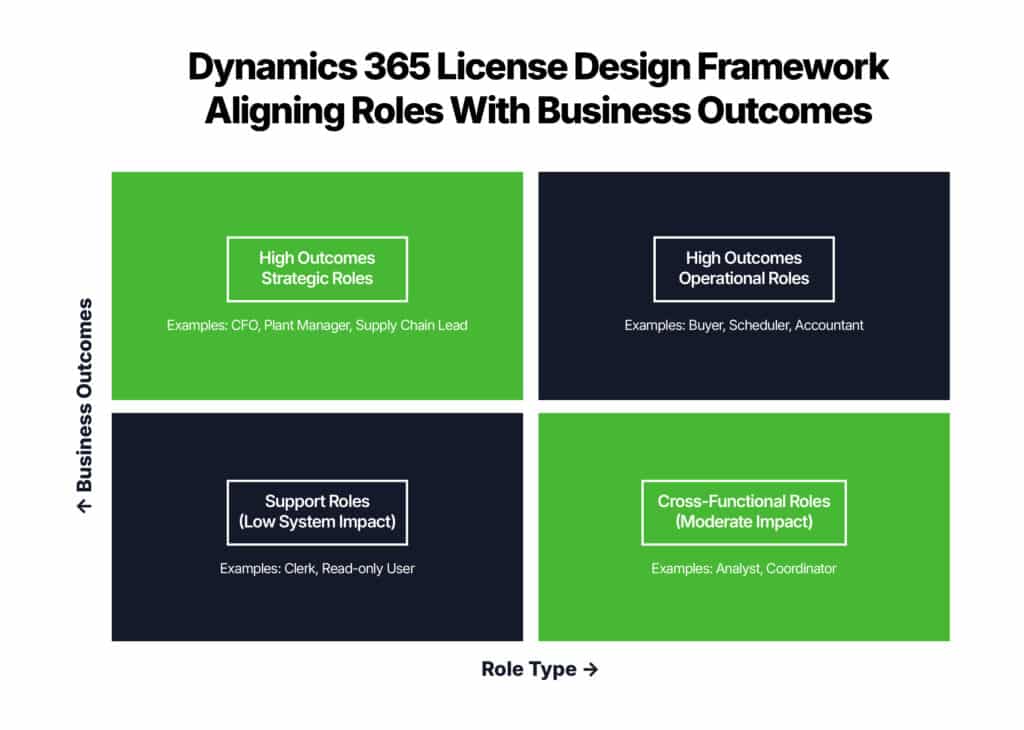
Adopt a role-based licensing strategy in Dynamics 365 by segmenting license needs into tiers:
- Strategic roles – CFOs, plant managers, and supply chain leaders who require advanced Finance & SCM capabilities.
- Operational roles – Buyers, schedulers, and accountants are responsible for executing repeatable processes.
- Support roles – Team members who need read-only access or limited transactional capabilities.
3. Optimize licenses across departments
Collaboration between Finance, Supply Chain, and IT is essential. Misaligned license allocation, such as assigning costly SCM licenses to Finance clerks, creates waste and undermines accountability. Aligning licenses with cross-departmental workflows ensures both efficiency and compliance.
4. Measure and iterate
Establish KPIs that tie directly to your Dynamics 365 licensing strategy:
- Financial close cycle time
- Supply chain fulfillment efficiency
- ROI on D365 Finance & SCM licensing investments
By treating license design as an iterative process rather than a one-time decision, organizations can continuously balance cost optimization, compliance, and business performance.
Case Study: How outcome-aligned licensing cut costs and improved planning cycles
Consider a $5B global manufacturer in discrete manufacturing that redesigned its Dynamics 365 Supply Chain Management licensing. By aligning planners, warehouse supervisors, and production schedulers to outcome-based roles, the company:
- Reduced licensing spend by 18% within a year.
- Shortened planning cycles by 25% through better alignment of SCM capabilities.
- Gave leadership visibility into cost-to-outcome ratios, making license spend a board-level conversation rather than an IT footnote.
This illustrates how license design as a strategy drives both efficiency and business transformation.
The organizational benefits of outcome-aligned licensing
Treating license design as a strategic discipline delivers tangible benefits:
- Financial Efficiency: Stop paying the ERP “license tax.” Eliminate wasted spend while scaling investments toward high-value roles.
- Operational Agility: Roles are equipped with exactly the tools they need, no more and no less.
- Governance & Compliance: Clear accountability reduces risk during audits and Microsoft’s enforcement cycles.
- Strategic Visibility: Linking license costs to business outcomes elevates licensing to the C-suite agenda.
Accelerate growth at an unprecedented pace
Discover how Confiz can help you take control of your daily operations, increasing growth and revenue.
Book a Free ConsultationLooking ahead: License design as a core capability
As enterprises adopt more advanced Dynamics 365 capabilities—such as AI copilots, predictive supply planning, and embedded analytics—the stakes of license design rise. If license allocation lags behind strategic priorities, the business cannot extract full value from its D365 investment.
The future belongs to organizations that view license design not as IT overhead, but as a lever for digital transformation. Those who master outcome-aligned license strategies in D365 Finance & SCM will not only control costs but also create a workforce that is license-optimized, role-enabled, and outcome-driven.
Conclusion: License design as strategy, not afterthought
License design is no longer a back-office concern—it is a strategic discipline that links ERP costs to outcomes. Enterprises that master outcome-aligned licensing will not only control spend but also unlock agility, resilience, and digital transformation.
At Confiz, we partner with CFOs, CIOs, and transformation leaders to operationalize this shift—moving beyond compliance toward license strategies that empower performance. If you’re ready to rethink licensing as a strategy, let’s start the conversation!
Connect with us today and let’s design a licensing strategy that works for your business outcomes.